Thursday, 29 November 2018
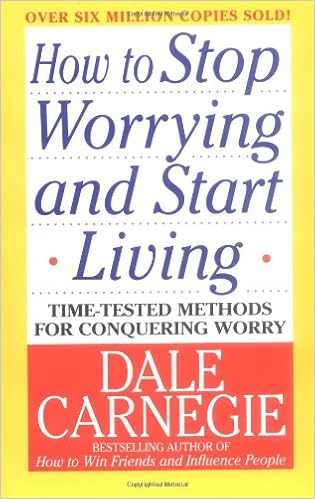
Review of Book " How to Stop Worrying and Start Living " Part 3
Hello guys! how are u today? I hope you wii be always in best condition and keep loyal visit and read my blog. Okey don't talk too much in the beginning. So, right now I would like to review the continue of last book that has a title " How to Stop Worrying and Start Living." exactly explanation of part 3 ( How To Break The Worry Habit Before It Breaks You ) that begins from chapter 6 until chapter 11. Well, I will discuss of each chapters.
Chapter 6 ( How To Crowd Worry Out Of Tour Mind )
When Marion J. Douglas was a student in one of my classes. (I have not used his real name. He requested me, for personal reasons, not to reveal his identity.) But here is his real story as he told it before one of our adult-education classes. He told us how tragedy had struck at his home, not once, but twice. The first time he had lost his five-year-old daughter, a child he adored. He and his wife thought they couldn't endure that first loss; but, as he said: "Ten months later, God gave us another little girl-and she died in five days." This double bereavement was almost too much to bear. "I couldn't take it," this father told us. "I couldn't sleep, I couldn't eat, I couldn't rest or relax. My nerves were utterly shaken and my confidence gone." At last he went to doctors; one recommended sleeping pills and another recommended a trip. He tried both, but neither remedy helped. He said: "My body felt as if it were encased in a vice, and the jaws of the vice were being drawn tighter and tighter." The tension of grief-if you have ever been paralysed by sorrow, you know what he meant. "But thank God, I had one child left-a four-year-old son. He gave me the solution to my problem. One afternoon as I sat around feeling sorry for myself, he asked: 'Daddy, will you build a boat for me?' I was in no mood to build a boat; in fact, I was in no mood to do anything. But my son is a persistent little fellow! I had to give in. "Building that toy boat took about three hours. By the time it was finished, I realised that those three hours spent building that boat were the first hours of mental relaxation and peace that I had had in months! "That discovery jarred me out of my lethargy and caused me to do a bit of thinking-the first real thinking I had done in months. I realised that it is difficult to worry while you are busy doing something that requires planning and thinking. In my case, building the boat had knocked worry out of the ring. So I resolved to keep busy. "The following night, I went from room to room in the house, compiling a list of jobs that ought to be done. Scores of items needed to be repaired: bookcases, stair steps, storm windows, window-shades, knobs, locks, leaky taps. Astonishing as it seems, in the course of two weeks I had made a list of 242 items that needed attention. "During the last two years I have completed most of them. Besides, I have filled my life with stimulating activities. Two nights per week I attend adult-education classes in New York. I have gone in for civic activities in my home town and I am now chairman of the school board. I attend scores of meetings. I help collect money for the Red Cross and other activities. I am so busy now that I have no time for worry." No time for worry! That is exactly what Winston Churchill said when he was working eighteen hours a day at the height of the war. When he was asked if he worried about his tremendous responsibilities, he said: "I'm too busy. I have no time for worry." Charles Kettering was in that same fix when he started out to invent a self-starter for automobiles. Mr. Kettering was, until his recent retirement, vice-president of General Motors in charge of the world-famous General Motors Research Corporation. But in those days, he was so poor that he had to use the hayloft of a barn as a laboratory. To buy groceries, he had to use fifteen hundred dollars that his wife had made by giving piano lessons; later, had to borrow five hundred dollars on his life insurance.
Chapter 7 ( Don't Let the Beetles Get You Down )
Here is a dramatic story that I'll probably remember as long as I live. It was told to me by Robert Moore, of 14 Highland Avenue, Maplewood, New Jersey. "I learned the biggest lesson of my life in March, 1945," he said, "I learned it under 276 feet of water off the coast of Indo-China. I was one of eighty-eight men aboard the submarine Baya S.S. 318. We had discovered by radar that a small Japanese convoy was coming our way. As daybreak approached, we submerged to attack. I saw through the periscope a Jap destroyer escort, a tanker, and a minelayer. We fired three torpedoes at the destroyer escort, but missed. Something went haywire in the mechanics of each torpedo. The destroyer, not knowing that she had been attacked, continued on. We were getting ready to attack the last ship, the minelayer, when suddenly she turned and came directly at us. (A Jap plane had spotted us under sixty feet of water and had radioed our position to the Jap minelayer.) We went down to 150 feet, to avoid detection, and rigged for a depth charge. We put extra bolts on the hatches; and, in order to make our sub absolutely silent, we turned off the fans, the cooling system, and all electrical gear. "Three minutes later, all hell broke loose. Six depth charges exploded all around us and pushed us down to the ocean floor -a depth of 276 feet. We were terrified. To be attacked in less than a thousand feet of water is dangerous-less than five hundred feet is almost always fatal. And we were being attacked in a trifle more than half of five hundred feet of water -just about knee-deep, as far as safety was concerned. For fifteen hours, that Jap minelayer kept dropping depth charges. If a depth charge explodes within seventeen feet of a sub, the concussion will blow a hole in it. Scores of these depth charges exploded within fifty feet of us. We were ordered 'to secure'- to lie quietly in our bunks and remain calm. I was so terrified I could hardly breathe. 'This is death,' I kept saying to myself over and over. 'This is death! ... This is death!' With the fans and cooling system turned off, the air inside the sub was over a hundred degrees; but I was so chilled with fear that I put on a sweater and a furlined jacket; and still I trembled with cold. My teeth chattered. I broke out in a cold, clammy sweat. The attack continued for fifteen hours. Then ceased suddenly. Apparently the Jap minelayer had exhausted its supply of depth charges, and steamed away. Those fifteen hours of attack seemed like fifteen million years. All my life passed before me in review. I remembered all the bad things I had done, all the little absurd things I had worried about. I had been a bank clerk before I joined the Navy. I had worried about the long hours, the poor pay, the poor prospects of advancement. I had worried because I couldn't own my own home, couldn't buy a new car, couldn't buy my wife nice clothes. How I had hated my old boss, who was always nagging and scolding! I remembered how I would come home at night sore and grouchy and quarrel with my wife over trifles. I had worried about a scar on my forehead-a nasty cut from an auto accident. "How big all these worries seemed years ago! But how absurd they seemed when depth charges were threatening to blow me to kingdom come. I promised myself then and there that if I ever saw the sun and the stars again, I would never, never worry again. Never! Never! I Never!!! I learned more about the art of living in those fifteen terrible.
Chapter 8 ( A Law That Will Outlaw Many of Tour Worries )
As a child, I grew up on a Missouri farm; and one day, while helping my mother pit cherries, I began to cry. My mother said: "Dale, what in the world are you crying about?" I blubbered: "I'm afraid I am going to be buried alive!" I was full of worries in those days. When thunderstorms came, I worried for fear I would be killed by lightning. When hard times came, I worried for fear we wouldn't have enough to eat. I worried for fear I would go to hell when I died. I was terrified for fear an older boy, Sam White, would cut off my big ears-as he threatened to do. I worried for fear girls would laugh at me if I tipped my hat to them. I worried for fear no girl would ever be willing to marry me. I worried about what I would say to my wife immediately after we were married. I imagined that we would be married in some country church, and then get in a surrey with fringe on the top and ride back to the farm ... but how would I be able to keep the conversation going on that ride back to the farm? How? How? I pondered over that earth-shaking problem for many an hour as I walked behind the plough. As the years went by, I gradually discovered that ninety-nine per cent of the things I worried about never happened. For example, as I have already said, I was once terrified of lightning; but I now know that the chances of my being killed by lightning in any one year are, according to the National Safety Council, only one in three hundred and fifty thousand. My fear of being buried alive was even more absurd: I don't imagine that one person in ten million is buried alive; yet I once cried for fear of it. One person out of every eight dies of cancer. If I had wanted something to worry about, I should have worried about cancer -instead of being killed by lightning or being buried alive. To be sure, I have been talking about the worries of youth and adolescence. But many of our adult worries are almost as absurd. You and I could probably eliminate ninetenths of our worries right now if we would cease our fretting long enough to discover whether, by the law of averages, there was any real justification for our worries. The most famous insurance company on earth-Lloyd's of London-has made countless millions out of the tendency of everybody to worry about things that rarely happen. Lloyd's of London bets people that the disasters they are worrying about will never occur. However, they don't call it betting. They call it insurance. But it is really betting based on the law of averages. This great insurance firm has been going strong for two hundred years; and unless human nature changes, it will still be going strong fifty centuries from now by insuring shoes and ships and sealing-wax against disasters that, by the law of average, don't happen nearly so often as people imagine. If we examine the law of averages, we will often be astounded at the facts we uncover. For example, if I knew that during the next five years I would have to fight in a battle as bloody as the Battle of Gettysburg, I would be terrified. I would take out all the life insurance I could get. I would draw up my will and set all my earthly affairs in order. I would say: "I'll probably never live through that battle, so I had better make the most of the few years I have left." Yet the facts are that, according to the law of averages, it is just as dangerous, just as fatal, to try to live from age fifty to age fifty-five in peace-time as it was to fight in the Battle of Gettysburg. What I am trying to say is this: in times of peace, just as many people die per thousand between the ages of fifty and fifty-five as were killed per thousand among the 163,000 soldiers who fought at Gettysburg. I wrote several chapters of this book at James Simpson's Num-Ti-Gah Lodge, on the shore of Bow Lake in the Canadian Rockies. While stopping there one summer, I met Mr. and Mrs. Herbert H. Salinger, of 2298 Pacific Avenue, San Francisco. Mrs. Salinger, a poised, serene woman, gave me the impression that she had never worried. One evening in front of the roaring fireplace, I asked her if she had ever been troubled by worry. "Troubled by it?" she said. "My life was almost ruined by it. Before I learned to conquer worry, I lived through eleven years of self-made hell. I was irritable and hot tempered. In additional, I also lived in under teriffic tension.
Chapter 9 ( Co-Operate With The Inevitable )
When I was a little boy, I was playing with some of my friends in the attic of an old,
abandoned log house in north-west Missouri. As I climbed down out of the attic, I rested
my feet on a window-sill for a moment-and then jumped. I had a ring on my left
forefinger; and as I jumped, the ring caught on a nailhead and tore off my finger.
I screamed. I was terrified. I was positive I was going to die. But after the hand healed, I
never worried about it for one split second. What would have been the use? ... I
accepted the inevitable.
Chapter 10 ( Put A " Stop-Loss" Order On Your Worries )
"I originally came up to New York from Texas with twenty thousand dollars which my friends had given me to invest in the stock market," Charles Roberts told me. "I thought," he continued, "that I knew the ropes in the stock market; but I lost every cent. True, I made a lot of profit on some deals; but I ended up by losing everything. "I did not mind so much losing my own money," Mr. Roberts explained, "but I felt terrible about having lost my friends' money, even though they could well afford it. I dreaded facing them again after our venture had turned out so unfortunately, but, to my astonishment, they not only were good sports about it, but proved to be incurable optimists. "I knew I had been trading on a hit-or-miss basis and depending largely on luck and other people's opinions. As H. I. Phillips said, I had been 'playing the stock market by ear'. "I began to think over my mistakes and I determined that before I went back into the market again, I would try to find out what it was all about. So I sought out and became acquainted with one of the most successful speculators who ever lived: Burton S. Castles. I believed I could learn a great deal from him because he had long enjoyed the reputation of being successful year after year and I knew that such a career was not the result of mere chance or luck. "He asked me a few questions about how I had traded before and then told me what I believe is the most important principle in trading. He said: 'I put a stop-loss order on every market commitment I make. If I buy a stock at, say, fifty dollars a share, I immediately place a stop-loss order on it at forty-five.' That means that when and if the stock should decline as much as five points below its cost, it would be sold automatically, thereby, limiting the loss to five points. " 'If your commitments are intelligently made in the first place,' the old master continued, 'your profits will average ten, twenty-five, or even fifty points. Consequently, by limiting your losses to five points, you can be wrong more than half of the time and still make plenty of money?' "I adopted that principle immediately and have used it ever since. It has saved my clients and me many thousands of dollars. "After a while I realised that the stop-loss principle could be used in other ways besides in the stock market. I began to place a stop-loss order on any and every kind of annoyance and resentment that came to me. It has worked like magic. "For example, I often have a luncheon date with a friend who is rarely on time. In the old days, he used to keep me stewing around for half my lunch hour before he showed up. Finally, I told him about my stop-loss orders on my worries. I said: 'Bill, my stop-loss order on waiting for you is exactly ten minutes. If you arrive more than ten minutes late, our luncheon engagement will be sold down the river-and I'll be gone.' " Man alive! How I wish I had had the sense, years ago, to put stop-loss orders on my impatience, on my temper, on my desire for self-justification, on my regrets, and on all my mental and emotional strains. Why didn't I have the horse sense to size up each situation that threatened to destroy my peace of mind and say to myself: "See here, Dale Carnegie, this situation is worth just so much fussing about and no more.
Chapter 11 ( Don't Try To Saw Sawdust )
As I write this sentence, I can look out of my window and see some dinosaur tracks in my garden-dinosaur tracks embedded in shale and stone. I purchased those dinosaur tracks from the Peabody Museum of Yale University; and I have a letter from the curator of the Peabody Museum, saying that those tracks were made 180 million years ago. Even a Mongolian idiot wouldn't dream of trying to go back 180 million years to change those tracks. Yet that would not be any more foolish than worrying because we can't go back and change what happened 180 seconds ago-and a lot of us are doing just that To be sure, we may do something to modify the effects of what happened 180 seconds ago but we can't possibly change the event that occurred then, There is only one way on God's green footstool that the past can be constructive; and that is by calmly analysing our past mistakes and profiting by them-and forgetting them. I know that is true; but have I always had the courage and sense to do it? To answer that question, let me tell you about a fantastic experience I had years ago. I let more than three hundred thousand dollars slip through my fingers without making a penny's profit. It happened like this: I launched a large-scale enterprise in adult education, opened branches in various cities, and spent money lavishly in overhead and advertising. I was so busy with teaching that I had neither the time nor the desire to look after finances. I was too naive to realise that I needed an astute business manager to watch expenses. Finally, after about a year, I discovered a sobering and shocking truth. I discovered that in spite of our enormous intake, we had not netted any profit whatever. After discovering that, I should have done two things. First, I should have had the sense to do what George Washington Carver, the Negro scientist, did when he lost forty thousand dollars in a bank crash-the savings of a lifetime. When someone asked him if he knew he was bankrupt, he replied: "Yes, I heard"-and went on with his teaching. He wiped the loss out of his mind so completely that he never mentioned it again.
Here are some a nutshell of part 3 - How To Break The Worry Habit Before It Breaks You.
CHAPTER 6: Crowd worry out of your mind by keeping busy. Plenty of action is one of the best
therapies ever devised for curing "wibber gibbers".
CHAPTER 7: Don't fuss about trifles. Don't permit little things-the mere termites of life-to ruin your happiness.
CHAPTER 8: Use the law of averages to outlaw your worries. Ask yourself: "What are the odds against this thing's happening at all?"
CHAPTER 9: Co-operate with the inevitable. If you know a circumstance is beyond your power to
change or revise, say to yourself "It is so; it cannot be otherwise.
CHAPTER 10:Put a "stop-loss" order on your worries. Decide just how much anxiety a thing may be worth-and refuse to give it any more.
CHAPTER 11: Let the past bury its dead. Don't saw sawdust.
Well, I think enough about explanation of part 3, I'm so sorry if there are many mistakes og my grammar. please give best sugges for this blog. Thank you.

Friday, 23 November 2018
Review of book " How to Stop Worrying and Start Living" part 2
PART 2 ( BASIC TECHNIQUES IN ANALYSING WORRY )
Hello guys, how are you today? I hope you will be always fine okey. Now, as usual I would like to share a review of book " How to stop worrying and start living" exactly in part 2. In part 2, contain 2 chapter ( chapter 4 and chapter 5 ). Okey, don't talk too much in opening, but I will give a few explanations of each chapters.
Chapters 4 ( How To Analyse And Solve Worry Problems )
In last explanation, we had known that there are a few magic formula for solving worry situation that stated by Willis H Carrier. However, based of chapter 3 these ways couldn't be worked optimal. So, to solve worry problems we need new methods and analyse the problems. According of chapter 3. there are 3 steps of problems analysis. The three steps are:
1. Get the facts
2. Analyse the facts
3. Arrive at a decision and then act on that decision.
The first one is get the facts. Before we want to solve the problems, we can get the facts formerly, because if we don't have facts, of course we will feel confused and cannot finish the problems. Therefore, based of chapter 3 explains that get the facts is one of important for solving problems.
The second one is analyse the facts. Based of chapter 3, analyse the facts are also important. In additional, according of writer , analyse is important because generally after get facts, we must analyse them and intrepet them. In fact, merely writing the facts on a piece of paper and stating our
problem clearly goes a long way toward helping us to reach a sensible decision. As
Charles Kettering puts it: "A problem well stated is a problem half solved." Therefore analyse the facts is one of important ways for solve worry problems. If we had analyse them well, so we can conclude and know our problems especially in worry problems.
The third one is Arrive at a decision and then act on that decision. Based of chapter 3 states that if we have a problem, we must be brave to accept consequences of each steps and camly coming to a decision. Moreover, when we got a problem we must be dare and throw a doubt when want to take a decision. If we have a doubt of course we will be worried, as a result, the problems don't be finished.
Chapter 5 ( How to Eliminate Fifty Per Cent of Tour Business Worries )
Based of this chapter to eliminate fifty per cent of tour business worries are there on our self. In additional, if we had been successful to finish, therefore our worrying feeling will be reduced and we become camly and enjoy in our bussiness.
Moreover, in chapter 5 there are also several suggestions on how to get the most out of this book.
In A Nutshell of suggestions:
1. Develop a deep, driving desire to master the principles of conquering worry.
2. Read each chapter twice before going on to the next one.
3. As you read, stop frequently to ask yourself how you can apply each suggestion.
4. Underscore each important idea.
5. Review this book each month.
6. Apply these principles at every opportunity. Use this volume as a working handbook to help you
solve your daily problems.
7. Make a lively game put of your learning by offering some friend a shilling every time he catches
you violating one of these principles.
8. Check up each week on the progress you are making. Ask yourself what mistakes you have made,
what improvement, what lessons you have learned for the future.
9. Keep a diary in the back of this book showing how and when you have applied these principles.
OK, I think enough about explanation of chapter 4 and 5 based of the book " How to stop worrying and start living " If there any mistakes of my written, please leave a comment because your correction is really useful for me.
Thank You
Friday, 16 November 2018
Review of book " How to Stop Worrying and Start Living " part 1
 Hello, guys How it is goin? I hope you will be always well because if God give you good condition, of course you will always visit my blog. Now I won't talk too much in introduction whereas, I will talk too much in content section. In this opportunity, I will give you an review or explanation book that I've read since last night. Honestly this task make me extremely dizzy. I must read one book that contains with a lot of parts that contain again a lot of chapters. However, when dizzy comes to my head, I consider that it's one of a challenge that must through by me. I must finish to read this book because I believe that this book is really useful for me and of course also useful for all readers that later will read the review of this book in my blog. Well right now, I want to share a review or a few explanation of my book that has a tittle " How to stop worrying and start living " This book is written by Dale Carnegie. According to me, this book is one of amazing book. I can say like that because I've read this book in a few chapters and the result is really interesting to be read. So, I think that this book is suitable for you that often feel worry and need new life. In additional, this book also saves a lot of tips, manners, solutions and solve when got the problems. Therefore it's one of things that succeeded make me encouraged to read this book.
 Part 1 ( Fundamental facts you should know about worry )
* Chapter 1 ( Day- tight compartment )
In this chapter, tell about a young man ( Sir William Osier ) that succeeded to change his life after reading a book that has 21 words. This book had a profound effect on his life. Initially he was worried about passing the final examination, worried about what to do, where to go, how to build a practice and how to make a living. However, after he is reading a book, he can handle these problems and lead a free life from worry " Our main business is not to see what lies dimly at a distance, but to do
what lies clearly at hand." After reading this quotes, I feel that when we got worry, we don't have to worry when got a problem we must be calm and quite to accept a problem.
In additional, Sir William Osier ever works and ever feel so lonely, give up until has a desire to suicide. Futhermore, He was afraid facing his life, He was afraid of everything. Then one day he read an article that lifted him out of my despondence and gave him the
courage to go on living. He shall never cease to be grateful for one inspiring sentence in
that article. It said: 'Every day is a new life to a wise man.' Based of this sentence He learned to forget the yesterdays and to
not-think of the tomorrows. Each morning he said to himself: 'Today is a new life.'
"I have succeeded in overcoming my fear of loneliness, my fear of want. I am happy and
fairly successful now and have a lot of enthusiasm and love for life. I know now that I
shall never again be afraid, regardless of what life hands me. I know now that I don't
have to fear the future. I know now that I can live one day at a time-and that 'Every day
is a new life to a wise man.' Based of chapter 1, in my opinion the writer teaches us to be a person who must go no, Life is just once. So, don't waste your time with the things that is not useful. Use your time to positive things. Don't worry about future because our destined is already decided by God. In additional, we must be grateful with what that owned by us. Don't worry about your problems because every problems certainly have solution and the most important thngs is effort, struggle and prays. If we have do these habits, so we will be avoided from various problems and never feel worried when facing problems.
* Chapter 2 ( A Magic Formula For Solving Worry Situations )
If you have a worry problem, apply the magic formula of Willis H. Carrier by doing these
three things:
1. Ask yourself,' 'What is the worst that can possibly happen?"
2. Prepare to accept it mentally.
3. Then calmly proceed to improve on the worst.
In chapter 2 is explaning about Sir William Osier that has a problem of his bussiness. He has oil company who is heritage of his father. Nevertheless, before his bussiness is falied. He always thinks about the fated and didn't know about destined in future. So, he always assumpts that every a success certainly there was a trouble including a failure of bussiness. The worst that can possibly happen is failure that comes suddenly. If that problems come to us certainly we will worry continously. such as we are afraid fall in povery, get trouble life etc.Therefore, we must think that a success is never eternal. it's just temporal and of course there was a problem that comes suddenly, So we must accept it mentally. When his bussiness is fail, then he decide to seek another occupation. In additional, he also well comprehend about oil, so it's become a chance to get new job. Thus, if we have ability cerinly we will be easy to receieve it. The point is accept it mentally and wise don't be worry about the failure that comes suddenly. At last is improve on the worst camly because if the problems is handle calmly so, we will be easier to accomplish the problem because the problem is just able to be accomplished when our mind is calm and fresh. So, throw far worry feeling when get a problem.
* Chapter 3
In chapter 3 is explaining about several diseases that caused by worry feeling. In real life worry is one of causing that appear a lot of diseases such as heart diseasae, hight blood pressure, rheumatism. These diseases is caused by worry feeling. In additional, head ache also caused by worry feeling emotional feeling and tension. This disease really disturb us to focus get something. Morever, this disease also hampers us in various activity. Futhermore, there was another disease that caused by worry feeling sunch as nervous breakdown, gastric pains and even to diabetes. Based of these disease certainly have several solutions such as do relaxation and recreation. these are more useful for our health to be spared of several diseases. In additional, listen favorite music, have enough sleep, faith in religion ( prays ) and always see the funny side of life ( make laughing ) also useful for decrease worried feeling in real life. If we have do these ways organized so, certainly we always feel enjoy and happy. ( Away from worried feeling ).
Ok readers, I think enough about an explanation or review based of book that I've read thankyou so much and please don't forget to leave a comment because your comment is really useful especially for me.
Wednesday, 14 November 2018
Life of pie
Hello, all readers! How are you? I hope you always be kind and health in order that will never forget to visit my beloved blog. Ok, Now as usual I would like to share the synopsis of fantastic book that teaches a lot of education, motivation and solution to solve the problem. Talk about this novel, actually this novel is really make me be interested to read cause from the first time I read this book, The story of this book is really make me nosy and unbelievable until I intend to finish well this book.

Title : Life of Pi
Author : Yann Martel
Page : 401 pages
Synopsis
This novel tells the story of Piscine Molitor Patel, commonly called Pi, the main character, an Indian descendant whose family originally worked in the hospitality business, then swerved to start a business in the zoo. At the beginning, the novel tells about how Pi's childhood was always surrounded by various animals until when he was growing up, he was so interested in learning various kinds of religious and divine teachings. The Pi family, which is a modern Indian family, made their parents never forbid Pi from studying or being bound by any religion. On his journey, Pi finally came in and out of mosques, churches, places of prayer for Jews and even on certain days he put incense and worshiped Hindu gods. One time with a steady heart, Pi asked his father to buy a prayer mat, but on the other hand he also wanted to be baptized. The reason, because he likes the teachings of divinity in Islam but he himself studied in Christian schools. By his father, Pi was then bought a prayer mat for prayer, and on another day he was baptized by the priest.
When Pi was 16 years old, Pi's parents decided to move to Canada and wanted to start a new life there. Various types of animals collection of zoos are sold one by one. but still there are still a number of animals left, and they have to transport them by ship to cross to Canada. On the day of departure, Pi then said goodbye to all his friends and teachers, even with people he did not know, because according to his parents, they would never return to India.
In fact, this Indian family trip didn't go smoothly. one day Pi woke up to hear the sound of the explosion on the ship. Pi wanted to wake up his older brother Ravi and his parents, but he was afraid. Finally he decided to check for himself what happened outside the ship. Arriving outside, Pi was shocked, apparently outside it was raining and windy even though Pi could not conclude that the weather could be called a storm and could sink the ship. But what made Pi the most shocked was the buffalo they brought from India off their cages and ran to and fro on whatever was on board. Pi had not had the chance to realize that with the shock of other animals appearing running around, then Pi just found out that the ship was tilted. Staggering Pi held the side of the ship to balance his body and with the energy he had, Pi then looked for the captain and crew, whoever was, the person responsible for the safety of their voyage. But what he got was very unexpected. On the edge of the boat's lifeboat, he saw several crew members gathered and when Pi called him, Pi was pulled by the crew and dropped into a lifeboat. A split second later, Pi saw that the ship had begun to sink and Pi did not know what the ship was like because it was too far away at the time of the Pacific Ocean. This is where the Pi story begins. Pi, a 16-year-old Indian child, was swayed in a lifeboat in the middle of the Pacific Ocean with several animals in it, a hyena, a broken zebra, a Borneo orang-utan, and Richard Parker; The Royal Bengal tiger weighs 225 kilograms. In its 227-day journey or more than 7 months swaying in the pacific ocean, there are various kinds of events that Pi experienced, starting from the eating process to eating these animals because of the demands of the needs that finally left Pi and Richard Parker the Royal Bengal Tiger who left over.
Well, I think that.s all the synopsis of " Life of Pi " novel, don't forget to leave a comment cause the correction is really useful for me and I know all the mistakes of my words. Thank you so much and see u.
Thursday, 8 November 2018
Stories for Rainy Days Volume II
Hello guys, welcome back to my blog. Nowdays, in this opportunities I would like to share you about the synopsis of book that has a title as "Stories for Rainy Days". This book is one of book that have romance genre. Most of contents of this book explain about loves. So, I decide to read this book well because this book not only contain about loves but this book also contain about motivation that particularly tell about concern, support or even to attention. Then, I really excited to read this book eventhough I don't really know about loves. Therefore, I think that this book is really appropiate for women who want to know the way of loves with women's pair and this book also suitable read by all women when rain is fall.

Tiltle : Stories for Rainy Days
Author : Naela Ali
Page : 208
Genre : Romance, Art Book, Short Story
Synopsis
Based of second book, this book more tells about the meeting between a figure "I" (woman) and her new boy friend. Initially a figure "I" is broken heart because separate with a figure "You". Then, a figure I finally meet with her new boy friend "He". The reason why a figure I leave her boy friend "You" because a figure I want to find new life so, the woman ( I ) decide to break with her boy friend and seek new life. In addition, a figure I also believe that every ending means new beginning. Thus a figure I (woman) find with a figure "He" so, the woman / I also believe that right after we were born, there was someone out there who meant to be our soul mate and the process is not as smooth as we think. It's full of struggles and obstacles but a figure I (woman) believe that it's will be worth it in the end. Moreover, this book also tells that (flashback). A figure I say that " I have been loved and loving" and "I have been hurted and hurting. Therefore, a figure I never fear of giving my heart to the person that I love. Even, a figure I also give them the key to the door of my happiness. A figure I also say that I let "Him" to broke it and play with it. But one thing that I never let him was to kill me and a figure I believe that those wounds didn't kill me yet it only made me stronger. Then, a figure I believe a figure "He" can control me and offers me comfort and safety. Futhermore, a figure I considered that there was a hint of doubt about him in my heart and I assumpted that he was the one destined for me. Hence, love is not a competition of winning each other's attention. Love is a teamwork. We are one, who fighting all the obstacles that might destroy us. I know there is nothing that should be worried. Because we are together and faith in each other.
I think that's all about the synopsis of "Stories for Rainy Days". If there are a few mistakes please dont be doubt to leave a comment, cause your comment is really useful especially for my self.
" THANK YOU"
Subscribe to:
Comments (Atom)
-
 Hello guys, long time no see, finally the task for making a brief resume in blog is back (LOL). Well, at the first explanation, I...
 -
Hello friends, long time no see, how are you all today? I hope all of you in good conditions today in order that keep on visitin...
-
Good Evening mates, How goes things? I hope all of you always in a health state and of course still loyal to read and visit my blog...