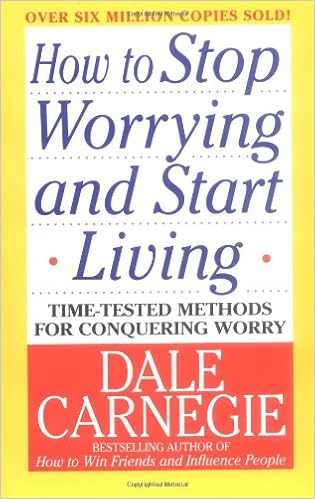
Hello guys. How is it going ? ok, now I'll continue my review in part 7. Currently, I'll tell all parts that related in part 7 ( Six Ways To Prevent Fatigue And Worry And Keep Your Energy And Spirits High ). Well, don't talk too much, directly I'll give an explanation of this part.
Chapter 23: How To Add One Hour A Day To Tour Waking Life
Did I say "tends to prevent worry"? That is putting it mildly. Dr. Edmund Jacobson goes much further. Dr. Jacob-son has written two books on relaxation: Progressive Relaxation and You Must Relax', and as director of the University of Chicago Laboratory for Clinical Physiology, he has spent years conducting investigations in using relaxation as a method in medical practice. He declares that any nervous or emotional state "fails to exist in the presence of complete relaxation". That is another way of saying: You cannot continue to worry if you relax. So, to prevent fatigue and worry, the first rule is: Rest often. Rest before you get tired. Why is that so important? Because fatigue accumulates with astonishing rapidity. The United States Army has discovered by repeated tests that even young men-men toughened by years of Army training-can march better, and hold up longer, if they throw down their packs and rest ten minutes out of every hour. So the Army forces them to do just that. Your heart is just as smart as the U.S. Army. Your heart pumps enough blood through your body every day to fill a railway tank car. It exerts enough energy every twenty-four hours to shovel twenty tons of coal on to a platform three feet high. It does this incredible amount of work for fifty, seventy, or maybe ninety years. How can it stand it? Dr. Walter B. Cannon, of the Harvard Medical School, explains it. He says: "Most people have the idea that the heart is working all the time. As a matter of fact, there is a definite rest period after each contraction. When beating at a moderate rate of seventy pulses per minute, the heart is actually working only nine hours out of the twenty-four. In the aggregate its rest periods total a full fifteen hours per day." During World War II, Winston Churchill, in his late sixties and early seventies, was able to work sixteen hours a day, year after year, directing the war efforts of the British Empire. A phenomenal record. His secret? He worked in bed each morning until eleven o'clock, reading papers, dictating orders, making telephone calls, and holding important conferences. After lunch he went to bed once more and slept for an hour. In the evening he went to bed once more and slept for two hours before having dinner at eight. He didn't cure fatigue. He didn't have to cure it. He prevented it. Because he rested frequently, he was able to work on, fresh and fit, until long past midnight. The original John D. Rockefeller made two extraordinary records. He accumulated the greatest fortune the world had ever seen up to that time and he also lived to be ninetyeight. How did he do it? The chief reason, of course, was because he had inherited a tendency to live long. Another reason was his habit of taking a half-hour nap in his office every noon. He would lie down on his office couch-and not even the President of the United States could get John D. on the phone while he was having his snooze! In his excellent book. Why Be Tired, Daniel W. Josselyn observes: "Rest is not a matter of doing absolutely nothing. Rest is repair." There is so much repair power in a short period of rest that even a five-minute nap will help to forestall fatigue! Connie Mack, the grand old man of baseball, told me that if he doesn't take an afternoon nap before a game, he is all tuckered out at around the fifth inning. But if he does go to sleep, if for only five minutes, he can last throughout an entire double-header without feeling tired. When I asked Eleanor Roosevelt how she was able to carry such an exhausting schedule during the twelve years she was in the White House, she said that before meeting a crowd or making a speech, she would often sit in a chair or davenport, close her eyes, and relax for twenty minutes.I recently interviewed Gene Autry in his dressing-room at Madison Square Garden, where he was the star attraction at the world's championship rodeo. I noticed an army cot in his dressing-room. "I lie down there every afternoon," Gene Autry said, "and get an hour's nap between performances. When I am making pictures in Hollywood," he continued, "I often relax in a big easy chair and get two or three ten-minute naps a day. They buck me up tremendously."
Chapter 24: What Makes You Tired-and What You Can Do About It
Here is an astounding and significant fact: Mental work alone can't make you tired. Sounds absurd. But a few years ago, scientists tried to find out how long the human brain could labour without reaching "a diminished capacity for work", the scientific definition of fatigue. To the amazement of these scientists, they discovered that blood passing through the brain, when it is active, shows no fatigue at all! If you took blood from the veins of a day labourer while he was working, you would find it full of "fatigue toxins" and fatigue products. But if you took a drop of blood from the brain of an Albert Einstein, it would show no fatigue toxins whatever at the end of the day. So far as the brain is concerned, it can work "as well and as swiftly at the end of eight or even twelve hours of effort as at the beginning". The brain is utterly tireless. ... So what makes you tired? Psychiatrists declare that most of our fatigue derives from our mental and emotional attitudes. One of England's most distinguished psychiatrists, J.A. Hadfield, says in his book The Psychology of Power: "the greater part of the fatigue from which we suffer is of mental origin; in fact exhaustion of purely physical origin is rare." One of America's most distinguished psychiatrists, Dr. A.A. Brill, goes even further. He declares: "One hundred per cent of the fatigue of the sedentary worker in good health is due to psychological factors, by which we mean emotional factors." What kinds of emotional factors tire the sedentary (or sitting) worker? Joy? Contentment? No! Never! Boredom, resentment, a feeling of not being appreciated, a feeling of futility, hurry, anxiety, worry-those are the emotional factors that exhaust the sitting worker, make him susceptible to colds, reduce his output, and send him home with a nervous headache. Yes, we get tired because our emotions produce nervous tensions in the body. The Metropolitan Life Insurance Company pointed that out in a leaflet on fatigue: "Hard work by itself," says this great life-insurance company, "seldom causes fatigue which cannot be cured by a good sleep or rest. ... Worry, tenseness, and emotional upsets are three of the biggest causes of fatigue. Often they are to blame when physical or mental work seems to be the cause. ... Remember that a tense muscle is a working muscle. Ease up! Save energy for important duties." Stop now, right where you are, and give yourself a check-up. As you read these lines, are you scowling at the book? Do you feel a strain between the eyes? Are you sitting relaxed in your chair? Or are you hunching up your shoulders? Are the muscles of your face tense? Unless your entire body is as limp and relaxed as an old rag doll, you are at this very moment producing nervous tensions and muscular tensions. You are producing nervous tensions and nervous fatigue!
Chapter 25: How The Housewife Can Avoid Fatigue-and Keep Looking Young
One day last autumn, my associate flew up to Boston to attend a session of one of the most unusual medical classes in the world. Medical? Well, yes, it meets once a week at the Boston Dispensary, and the patients who attend it get regular and thorough medical examinations before they are admitted. But actually this class is a psychological clinic. Although it is officially called the Class in Applied Psychology (formerly the Thought Control Class-a name suggested by the first member), its real purpose is to deal with people who are ill from worry. And many of these patients are emotionally disturbed housewives. How did such a class for worriers get started? Well, in 1930, Dr. Joseph H. Pratt-who, by the way, had been a pupil of Sir William Osier-observed that many of the outpatients who came to the Boston Dispensary apparently had nothing wrong with them at all physically; yet they had practically all the symptoms that flesh is heir to. One woman's hands were so crippled with "arthritis" that she had lost all use of them. Another was in agony with all the excruciating symptoms of "cancer of the stomach". Others had backaches, headaches, were chronically tired, or had vague aches and pains. They actually felt these pains. But the most exhaustive medical examinations showed that nothing whatever was wrong with these women-in the physical sense. Many oldfashioned doctors would have said it was all imagination-"all in the mind."
Chapter 26: Four Good Working Habits That Will Help Prevent Fatigue And Worry
Good Working Habit No. 1: Clear Your Desk of All Papers Except Those Relating to the Immediate Problem at Hand. Roland L. Williams, President of Chicago and North-western Railway, says: "A person with his desk piled high with papers on various matters will find his work much easier and more accurate if he clears that desk of all but the immediate problem on hand. I call this good housekeeping, and it is the number-one step towards efficiency." If you visit the Library of Congress in Washington, D.C., you will find five words painted on the ceiling-five words written by the poet Pope: "Order is Heaven's first law." Order ought to be the first law of business, too. But is it? No, the average business man's desk is cluttered up with papers that he hasn't looked at for weeks. In fact, the publisher of a New Orleans newspaper once told me that his secretary cleared up one of his desks and found a typewriter that had been missing for two years! The mere sight of a desk littered with unanswered mail and reports and memos is enough to breed confusion, tension, and worries. It is much worse than that. The constant reminder of "a million things to do and no time to do them" can worry you not only into tension and fatigue, but it can also worry you into high blood pressure, heart trouble, and stomach ulcers. Dr. John H. Stokes, professor, Graduate School of Medicine, University of Pennsylvania, read a paper before the National Convention of the American Medical Association-a paper entitled "Functional Neuroses as Complications of Organic Disease". In that paper, Dr. Stokes listed eleven conditions under the title: "What to Look for in the Patient's State of Mind". Here is the first item on that list: "The sense of must or obligation; the unending stretch of things ahead that simply have to be done." But how can such an elementary procedure as clearing your desk and making decisions help you avoid this high pressure, this sense of must, this sense of an "unending stretch of things ahead that simply have to be done"? Dr. William L. Sadler, the famous psychiatrist, tells of a patient who, by using this simple device, avoided a nervous breakdown. The man was an executive in a big Chicago firm. When he came to Dr. Sadler's office, he was tense, nervous, worried. He knew he was heading for a tailspin, but he couldn't quit work. He had to have help. "While this man was telling me his story," Dr. Sadler says, "my telephone rang. It was the hospital calling; and, instead of deferring the matter, I took time right then to come to a decision. I always settle questions, if possible, right on the spot. I had no sooner hung up than the phone rang again. Again an urgent matter, which I took time to discuss. The third interruption came when a colleague of mine came to my office for advice on a patient who was critically ill. When I had finished with him, I turned to my caller and began to apologise for keeping him waiting. But he had brightened up. He had a completely different look on his face."
Chapter 27 : How To Banish The Boredom That Produces Fatigue, Worry And Resentment
One of the chief causes of fatigue is boredom. To illustrate, let's take the case of Alice, a stenographer who lives on your street. Alice came home one night utterly exhausted. She acted fatigued. She was fatigued. She had a headache. She had a backache. She was so exhausted she wanted to go to bed without waiting for dinner. Her mother pleaded ... . She sat down at the table. The telephone rang. The boy friend! An invitation to a dance! Her eyes sparkled. Her spirits soared. She rushed upstairs, put on her Aliceblue gown, and danced until three o'clock in the morning; and when she finally did get home, she was not the slightest bit exhausted. She was, in fact, so exhilarated she couldn't fall asleep. Was Alice really and honestly tired eight hours earlier, when she looked and acted exhausted? Sure she was. She was exhausted because she was bored with her work, perhaps bored with life. There are millions of Alices. You may be one of them. It is a well-known fact that your emotional attitude usually has far more to do with producing fatigue than has physical exertion. A few years ago, Joseph E. Barmack, Ph.D., published in the Archives of Psychology a report of some of his experiments vshowing how boredom produces fatigue. Dr. Barmack put a group of students through a series of tests in which, he knew, they could have little interest. The result? The students felt tired and sleepy, complained of headaches and eyestrain, felt irritable. In some cases, even their stomachs were upset. Was it all "imagination"? No. Metabolism tests were taken of these students. These tests showed that the blood pressure of the body and the consumption of oxygen actually decrease when a person is bored, and that the whole metabolism picks up immediately as soon as he begins to feel interest and pleasure in his work! We rarely get tired when we are doing something interesting and exciting. For example, I recently took a vacation in the Canadian Rockies up around Lake Louise. I spent several days trout fishing along Corral Creek, fighting my way through brush higher than my head, stumbling over logs, struggling through fallen timber-yet after eight hours of this, I was not exhausted. Why? Because I was excited, exhilarated. I had a sense of high achievement: six cut-throat trout. But suppose I had been bored by fishing, then how do you think I would have felt? I would have been worn out by such strenuous work at an altitude of seven thousand feet.
Chapter 28 ( How To Keep From Worrying About Insomnia )
Do you worry when you can't sleep well? Then it may interest you to know that Samuel Untermyer-the famous international lawyer-never got a decent night's sleep in his life. When Sam Untermyer went to college, he worried about two afflictions-asthma and insomnia. He couldn't seem to cure either, so he decided to do the next best thing-take advantage of his wakefulness. Instead of tossing and turning and worrying himself into a breakdown, he would get up and study. The result? He began ticking off honours in all of his classes, and became one of the prodigies of the College of the City of New York. Even after he started to practice law, his insomnia continued. But Untermyer didn't worry. "Nature," he said, "will take care of me." Nature did. In spite of the small amount of sleep he was getting, his health kept up and he was able to work as hard as any of the young lawyers of the New York Bar. He even worked harder, for he worked while they slept! At the age of twenty-one, Sam Untermyer was earning seventy-five thousand dollars a year; and other young attorneys rushed to courtrooms to study his methods. In 1931, he was paid-for handling one case-what was probably the highest lawyer's fee in all history: a cool million dollars-cash on the barrelhead. Still he had insomnia-read half the night-and then got up at five A.M. and started dictating letters. By the time most people were just starting work, his day's work would be almost half done. He lived to the age of eighty-one, this man who had rarely had a sound night's sleep; but if he had fretted and worried about his insomnia, he would probably have wrecked his life. We spend a third of our lives sleeping-yet nobody knows what sleep really is. We know it is a habit and a state of rest in which nature knits up the ravelled sleeve of care, but we don't know how many hours of sleep each individual requires. We don't even know if we have to sleep at all! Fantastic? Well, during the First World War, Paul Kern, a Hungarian soldier, was shot through the frontal lobe of his brain. He recovered from the wound, but curiously enough, couldn't fall asleep. No matter what the doctors did-and they tried all kinds of sedatives and narcotics, even hypnotism- Paul Kern couldn't be put to sleep or even made to feel drowsy. The doctors said he wouldn't live long. But he fooled them. He got a job, and went on living in the best of health for years. He would lie down and close his eyes and rest, but he got no sleep whatever. His case was a medical mystery that upset many of our beliefs about sleep. Some people require far more sleep than others. Toscanini needs only five hours a night, but Calvin Coolidge needed more than twice that much. Coolidge slept eleven hours out of every twenty-four. In other words, Toscanini has been sleeping away approximately one-fifth of his life, while Coolidge slept away almost half of his life. Worrying about insomnia will hurt you far more than insomnia. For example, one of my students-Ira Sandner, of 173 Overpeck Avenue, Ridgefield Park, New Jersey-was driven nearly to suicide by chronic insomnia. "I actually thought I was going insane," Ira Sandner told me. "The trouble was, in the beginning, that I was too sound a sleeper. I wouldn't wake up when the alarm clock went off, and the result was that I was getting to work late in the morning. I worried about itand, in fact, my boss warned me that I would have to get to work on time. I knew that if I kept on oversleeping, I would lose my job. "I told my friends about it, and one of them suggested I concentrate hard on the alarm clock before I went to sleep. That started the insomnia! The tick-tick-tick of that blasted alarm clock became an obsession. It kept me awake, tossing, all night long! When morning came, I was almost ill. I was ill from fatigue and worry. This kept on for eight weeks. I can't put into words the tortures I suffered. I was convinced I was going insane. Sometimes I paced the floor for hours at a time, and I honestly considered jumping out of the window and ending the whole thing! "At last I went to a doctor I had known all my life. He said: 'Ira, I can't help you. No one can help you, because you have brought this thing on yourself. Go to bed at night, and if you can't fall asleep, forget all about it. Just say to yourself: "I don't care a hang if I don't go to sleep. It's all right with me if I lie awake till morning." Keep your eyes closed and say: "As long as I just lie still and don't worry about it, I'll be getting rest, anyway."
Well, that's all explanation of me. If there are many mistakes of my words, please don't be hesitate to correct my word. Moreover, please give your advice to support my writting skill.
- Thank You-


Cool
ReplyDelete