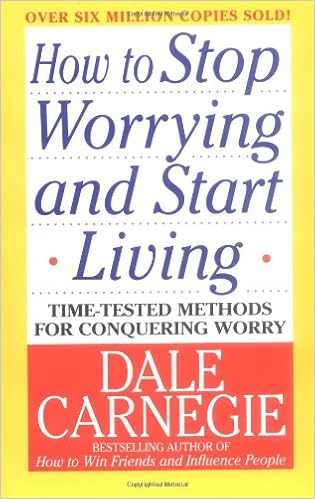
Hello guys, welcome back to my blog. Today, I would like to inform you the result of my review book. It is still same, I still continue my last book. In this chance, I will give a review of book based on part 6 ( How To Keep From Worrying About Criticism ). Well, directly I'll give you an explanation based of part 6.
Chapter 20 ( Remember That No One Ever Kicks A Dead Dog )
An event occurred in 1929 that created a national sensation in educational circles. Learned men from all over America rushed to Chicago to witness the affair. A few years earlier, a young man by the name of Robert Hutchins had worked his way through Yale, acting as a waiter, a lumberjack, a tutor, and a clothes-line salesman. Now, only eight years later, he was being inaugurated as president of the fourth richest university in America, the University of Chicago. His age? Thirty. Incredible! The older educators shook their heads. Criticism came roaring down upon the "boy wonder" like a rockslide. He was this and he was that-too young, inexperienced-his educational ideas were cockeyed. Even the newspapers joined in the attack. The day he was inaugurated, a friend said to the father of Robert Maynard Hutchins: "I was shocked this morning to read that newspaper editorial denouncing your son." "Yes," the elder Hutchins replied, "it was severe, but remember that no one ever kicks a dead dog." Yes, and the more important a dog is, the more satisfaction people get in kicking him. The Prince of Wales who later became Edward VIII (now Duke of Windsor) had that forcibly brought home to him. He was attending Dartmouth College in Devonshire at the time-a college that corresponds to the Naval Academy at Annapolis. The Prince was about fourteen. One day one of the naval officers found him crying, and asked him what was wrong. He refused to tell at first, but finally admitted the truth: he was being kickedAn event occurred in 1929 that created a national sensation in educational circles. Learned men from all over America rushed to Chicago to witness the affair. A few years earlier, a young man by the name of Robert Hutchins had worked his way through Yale, acting as a waiter, a lumberjack, a tutor, and a clothes-line salesman. Now, only eight years later, he was being inaugurated as president of the fourth richest university in America, the University of Chicago. His age? Thirty. Incredible! The older educators shook their heads. Criticism came roaring down upon the "boy wonder" like a rockslide. He was this and he was that-too young, inexperienced-his educational ideas were cockeyed. Even the newspapers joined in the attack. The day he was inaugurated, a friend said to the father of Robert Maynard Hutchins: "I was shocked this morning to read that newspaper editorial denouncing your son." "Yes," the elder Hutchins replied, "it was severe, but remember that no one ever kicks a dead dog." Yes, and the more important a dog is, the more satisfaction people get in kicking him. The Prince of Wales who later became Edward VIII (now Duke of Windsor) had that forcibly brought home to him. He was attending Dartmouth College in Devonshire at the time-a college that corresponds to the Naval Academy at Annapolis. The Prince was about fourteen. One day one of the naval officers found him crying, and asked him what was wrong. He refused to tell at first, but finally admitted the truth: he was being kicked by the naval cadets. The commodore of the college summoned the boys and explained to them that the Prince had not complained, but he wanted to find out why the Prince had been singled out for this rough treatment. After much hemming and hawing and toe scraping, the cadets finally confessed that when they themselves became commanders and captains in the King's Navy, they wanted to be able to say that they had kicked the King! So when you are kicked and criticised, remember that it is often done because it gives the kicker a feeling of importance. It often means that you are accomplishing something and are worthy of attention. Many people get a sense of savage satisfaction out of denouncing those who are better educated than they are or more successful. For example, while I was writing this chapter, I received a letter from a woman denouncing General William Booth, founder of the Salvation Army. I had given a laudatory broadcast about General Booth; so this woman wrote me, saying that General Booth had stolen eight million dollars of the money he had collected to help poor people. The charge, of course, was absurd. But this woman wasn't looking for truth. She was seeking the mean-spirited gratification that she got from tearing down someone far above her. I threw her bitter letter into the wastebasket, and thanked Almighty God that I wasn't married to her. Her letter didn't tell me anything at all about General Booth, but it did tell me a lot about her. Schopenhauer had said it years ago: "Vulgar people take huge delight in the faults and follies of great men."
Chapter 21 ( Do This-and Criticism Can't Hurt You )
I once interviewed Major-General Smedley Butler-old "Gimlet-Eye". Old "Hell-Devil" Butler! Remember him? The most colourful, swashbuckling general who ever commanded the United States Marines. He told me that when he was young, he was desperately eager to be popular, wanted to make a good impression on everyone. In those days the slightest criticism smarted and stung. But he confessed that thirty years in the Marines had toughened his hide. "I have been berated and insulted," he said, "and denounced as a yellow dog, a snake, and a skunk. I have been cursed by the experts. I have been called every possible combination of unprintable cuss words in the English language. Bother me? Huh! When I hear someone cussing me now, I never turn my head to see who is talking." Maybe old "Gimlet-Eye" Butler was too indifferent to criticism; but one thing is sure: most of us take the little jibes and javelins that are hurled at us far too seriously. I remember the time, years ago, when a reporter from the New York Sun attended a demonstration meeting of my adult-education classes and lampooned me and my work. Was I burned up? I took it as a personal insult. I telephoned Gill Hodges, the Chairman of the Executive Committee of the Sun, and practically demanded that he print an article stating the facts-instead of ridicule. I was determined to make the punishment fit the crime. I am ashamed now of the way I acted. I realise now that half the people who bought the paper never saw that article. Half of those who read it regarded it as a source of innocent merriment. Half of those who gloated over it forgot all about it in a few weeks. I realise now that people are not thinking about you and me or caring what is said about us. They are thinking about themselves-before breakfast, after breakfast, and right on until ten minutes past midnight. They would be a thousand times more concerned about a slight headache of their own than they would about the news of your death or mine.
Chapter 22 ( Fool Things I Have Done )
I have a folder in my private filing cabinet marked "FTD"- short for "Fool Things I Have Done". I put in that folder written records of the fools things I have been guilty of. I sometimes dictate these memos to my secretary, but sometimes they are so personal, so stupid, that I am ashamed to dictate them, so I write them out in longhand. I can still recall some of the criticisms of Dale Carnegie that I put in my "FTD" folders fifteen years ago. If I had been utterly honest with myself, I would now have a filing cabinet bursting out at the seams with these "FTD" memos. I can truthfully repeat what King Saul said more than twenty centuries ago: "I have played the fool and have erred exceedingly." When I get out my "FTD" folders and re-read the criticisms I have written of myself, they help me deal with the toughest problem I shall ever face: the management of Dale Carnegie. I used to blame my troubles on other people; but as I have grown older-and wiser, I hope-I have realised that I myself, in the last analysis, am to blame for almost all my misfortunes. Lots of people have discovered that, as they grow older. "No one but have been my own greatest enemy-the cause of my own disastrous fate." Let me tell you about a man I know who was an artist when it came to self-appraisal and self-management. His name was H. P. Howell. When the news of his sudden death in the drugstore of the Hotel Ambassador in New York was flashed across the nation on July 31, 1944, Wall Street was shocked, for he was a leader in American financechairman of the board of the Commercial National Bank and Trust Company, 56 Wall Street, and a director of several large corporations. He grew up with little formal education, started out in life clerking in a country store, and later became credit manager for U.S. Steel- and was on his way to position and power.
There ara nutshell of part 6 - How To Keep From Worrying About Criticism
RULE 1: Unjust criticism is often a disguised compliment. It often means that you have aroused jealousy and envy. Remember that no one ever kicks a dead dog.
RULE 2: Do the very best you can; and then put up your old umbrella and keep the rain of criticism from running down the back of your neck.
RULE 3: Let's keep a record of the fool things we have done and criticise ourselves. Since we can't hope to be perfect, let's do what E. H. Little did: let's ask for unbiased, helpful, constructive criticism.
Yeah, I think enough an explanation based of book " How to Stop Worrying and Start Living. " I'm sorry for many mistakes of my words. Please don't be doubt to give an advice for me, because if you give me an advice, I think it's really useful for me.
- Thank You-


No comments:
Post a Comment